Article: How to Measure for Furniture Delivery
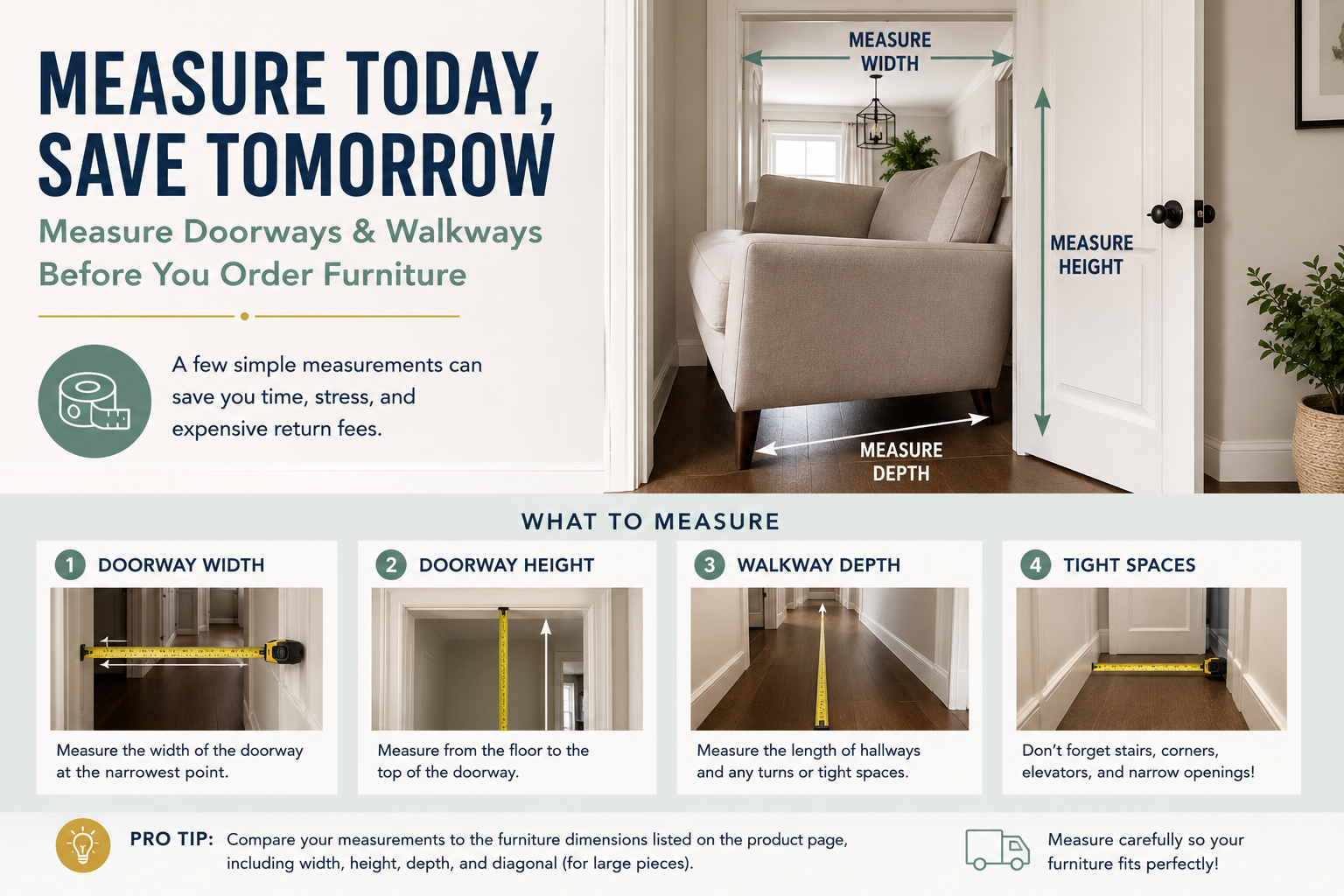
How to Measure for Furniture Delivery
The most common furniture delivery surprise is a piece that doesn't fit through the front door — or makes it through the door but won't turn down the hallway. It's more common than most people expect, and it's completely preventable. Here's exactly what to measure before you order, and what to bring to our showroom so we can help you confirm fit before you commit.
What You Need
A tape measure and something to write on. That's it. Five measurements done right will tell you everything you need to know.
Step 1: Measure Your Front Door
Measure the width of the doorframe opening — not the door itself, but the clear opening when the door is fully open. Standard interior doorways run 32 to 36 inches wide; older homes sometimes narrow to 28 or 30. Also note the height of the opening and whether a storm door is present. A storm door that opens outward significantly reduces the maneuvering space available to delivery teams working a large piece through the entry.
Step 2: Measure Hallways and Turns
Walk the route from your front door to the room where the furniture will live. Measure the width of any hallway along that path. If there's a turn — especially a 90-degree turn — measure the width of both hallway sections leading into the corner. Tight turns are where large sofas and sectionals most often cause problems. The piece has to rotate through the corner, which requires more clearance than the furniture's width alone.
Step 3: Measure Stairways
If the furniture needs to go up or down stairs, measure the stair width and the ceiling height at the lowest point of the stairwell (usually where the upper floor meets the stairway). If there's a landing or a turn in the staircase, measure the landing depth as well. Straight staircases are manageable; staircases with turns require careful planning for large pieces.
Step 4: Measure Interior Doorways
Don't stop at the front door. Measure every doorway the piece needs to pass through on the way to its final location — including interior doors that are typically left open. A 36-inch sofa that clears your front door can still get stuck at a 30-inch interior doorway two rooms in.
Step 5: Measure the Room Itself
Measure the wall length where the sofa, sectional, or chair will sit. Factor in walking clearance — you want at least 36 inches between the front of your seating and anything across from it (a coffee table, TV stand, or opposite wall). Also note any existing pieces that are staying in the room, and whether there are windows, vents, or radiators that limit where furniture can go.
A Note on Sectionals
If access is tight and you love a sectional configuration, don't rule it out yet. Many Bassett and Palliser sectionals are ordered in individual pieces — a left-arm sofa, a right-arm sofa, a corner piece, and ottomans — that are delivered and assembled in the room. Individual sections are typically 36 to 42 inches wide, which clears most standard doorways and hallways with room to maneuver. Let us know your access constraints at the time of purchase and we'll build the order to work with your home.
What to Bring to the Showroom
Write down your five key measurements before you visit — front door width, hallway width at the narrowest point, any turn dimensions, stair width if applicable, and the wall length in the destination room. Photos of your room on your phone are even more helpful. Our team will look at your measurements alongside the pieces you're considering and tell you honestly whether the configuration works — before you order anything.
We're at 1125 Cromwell Bridge Rd in Towson, Monday through Saturday 11AM–7PM and Sunday 12–5PM.